
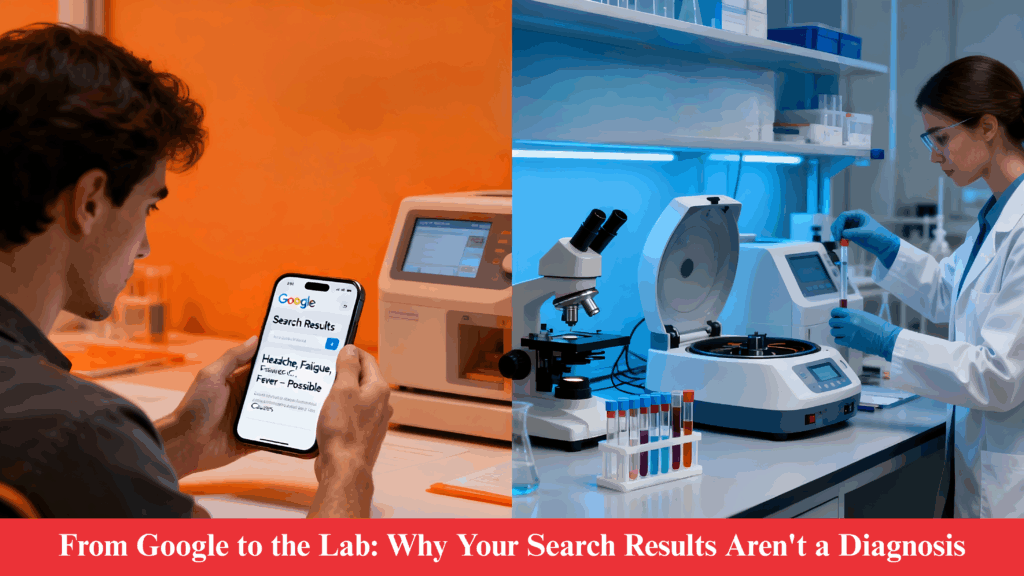
We’ve surely’. all done it.
A slight fever, a headache that wouldn’t go away, or a strange body ache—and within minutes, we’re on Google typing “why am I feeling,” only to scroll through pages of alarming possibilities. Before long, we are convinced it’s something serious, and anxiety takes over.
Whereas the internet is an excellent source of information, it is not a substitute for medical diagnosis. Symptom-based searching online can give an instant sense of reassurance or panic but barely ever delivers the full truth. That is where diagnostic testing comes in: it can turn guesses into facts and symptoms into answers.
The Pitfalls of “Dr. Google”
Online symptom searching, aka “cyberchondria,” is now incredibly prevalent. In fact, according to research, almost 7 in 10 people research their health symptoms before visiting the doctor. And here is where the clincher is: search results are mostly generalized content meant for millions of readers and definitely not personalized medical data.
For example, you type in “headache and fatigue.” Estimates can run the gamut from dehydration to brain tumor, also. This leads to two possibilities:
• You panic and assume the worst.
• You ignore it, thinking it’s nothing serious.
Both situations can be harmful. Misinterpretation of online information can result in delayed diagnosis, anxiety, or self-medication, which can be dangerous.
Why Lab Tests Are the Real Game-Changer?
Lab testing doesn’t guess; it measures and confirms with personalized reports. Each of our diagnostic tests is scientifically validated and is performed under strict quality standards.
And when you go to a diagnostic lab, what is being collected isn’t just your blood sample but also this opportunity to let your body express itself with accuracy and precision.
Here’s why diagnostic tests are crucial:
1. Accuracy over Assumption: Laboratory reports carry concrete, numerical data about your health that cannot be interpreted through online searches.
2. Early Detection: Many serious conditions, such as diabetes, thyroid disorders, or liver dysfunction, begin silently. Only routine testing can find them early.
3. Guided Treatment: The test results will guide the physician to a better treatment plan—right from medication to the follow-up.
4. Preventive Care: Regular diagnostic screening helps in tracking your health even before symptoms appear.
Atulaya Healthcare works on bridging this gap by ensuring that every report reflects precision, accuracy, reliability, and care.
A Simple Example
Suppose two individuals present themselves with similar complaints—tiredness, mood swings, and weight gain.
• Person A looks up symptoms online and decides it’s “stress,” then attempts home remedies.
• The person goes to a doctor and undergoes a thyroid function test; this is where hypothyroidism becomes detected.
The difference? One relies on guesses, the other on science.
Only through diagnostics can we move from assumption to awareness.
Being a Smarter Health Searcher
It is not wrong to use Google; it’s how you use it.
Here are a few smart habits:
• Use the internet to learn, not to diagnose.
• Always confirm your results with a qualified doctor.
• If the symptoms persist, get the recommended lab tests instead of self-medication.
• Remember, everyone’s body is unique — one-size-fits-all information rarely applies to health.
After all, at the end of the day, your health deserves more than mere speculation; it needs scientific validation.
The Atulaya Approach
Atulaya Healthcare blends advanced diagnostic technology with a patient-centered approach. Be it a simple blood test or advanced molecular diagnostics, every result is processed under strict quality control to assure accuracy and dependability.
We empower individuals with the right information, not through fear or guesswork but through facts and findings. From pathology to radiology, we are committed to helping you and your doctor make informed health decisions every single time. Conclusion Living in a digital world, the information is easy to access, but interpretation requires proficiency. Your symptoms deserve more than a search bar; they deserve the precision of diagnostic science. Next time you’re tempted to Google your symptoms, take a deep breath and remember: “The internet gives you possibilities, but the lab gives you proof.” Make the smarter choice. Move from Google to the Lab—where real answers begin.